
Blog
How to Rebuild a Household Contents Inventory After a Total-Loss Wildfire
A contents inventory after a house fire is the backbone of your insurance claim, but a total-loss wildfire destroys the receipts and photos you'd normally use to build one. This guide shows how to reconstruct an itemized, room-by-room inventory from digital records, financial statements, and retailer order histories, and when to bring in a professional appraiser.
When a wildfire takes the house along with everything in it, the insurer still wants the same thing it would ask of any other claim: a written, itemized list of what you owned, room by room, with evidence behind each line. That expectation does not bend just because the receipts, the safe, and the filing cabinet burned too. This guide walks through rebuilding that inventory from scratch, using the digital and financial trail most households leave behind even when every physical record is gone, and it explains when a wildfire contents appraisal from our team should carry the heaviest line items.
Why Insurers Require a Room-by-Room Written Inventory, Even After a Total Loss
Insurers and disaster-assistance programs consistently ask for the same structure: an itemized list organized by room or category, with a description, an estimated value, and supporting evidence for each item. FEMA's own property-documentation checklist calls for an itemized contents inventory with estimated costs or quotes, and asks for stronger proof, such as a receipt, comparable-item estimate, or appraisal, for any single item valued at $1,000 or more.
That standard exists because adjusters cannot evaluate a claim that says "lost everything, pay me." They need a document they can cross-check against policy limits, sublimits, and depreciation schedules. Starting room by room, rather than trying to recall the whole house at once, is also simply easier on the person doing the remembering. It breaks an overwhelming task into pieces small enough to finish.
Key takeaway: The inventory does not need to be perfect on the first pass. It needs to be structured, itemized, and backed by whatever evidence you can still produce.
Walk the Floor Plan First: A Room-by-Room Memory Reconstruction Method
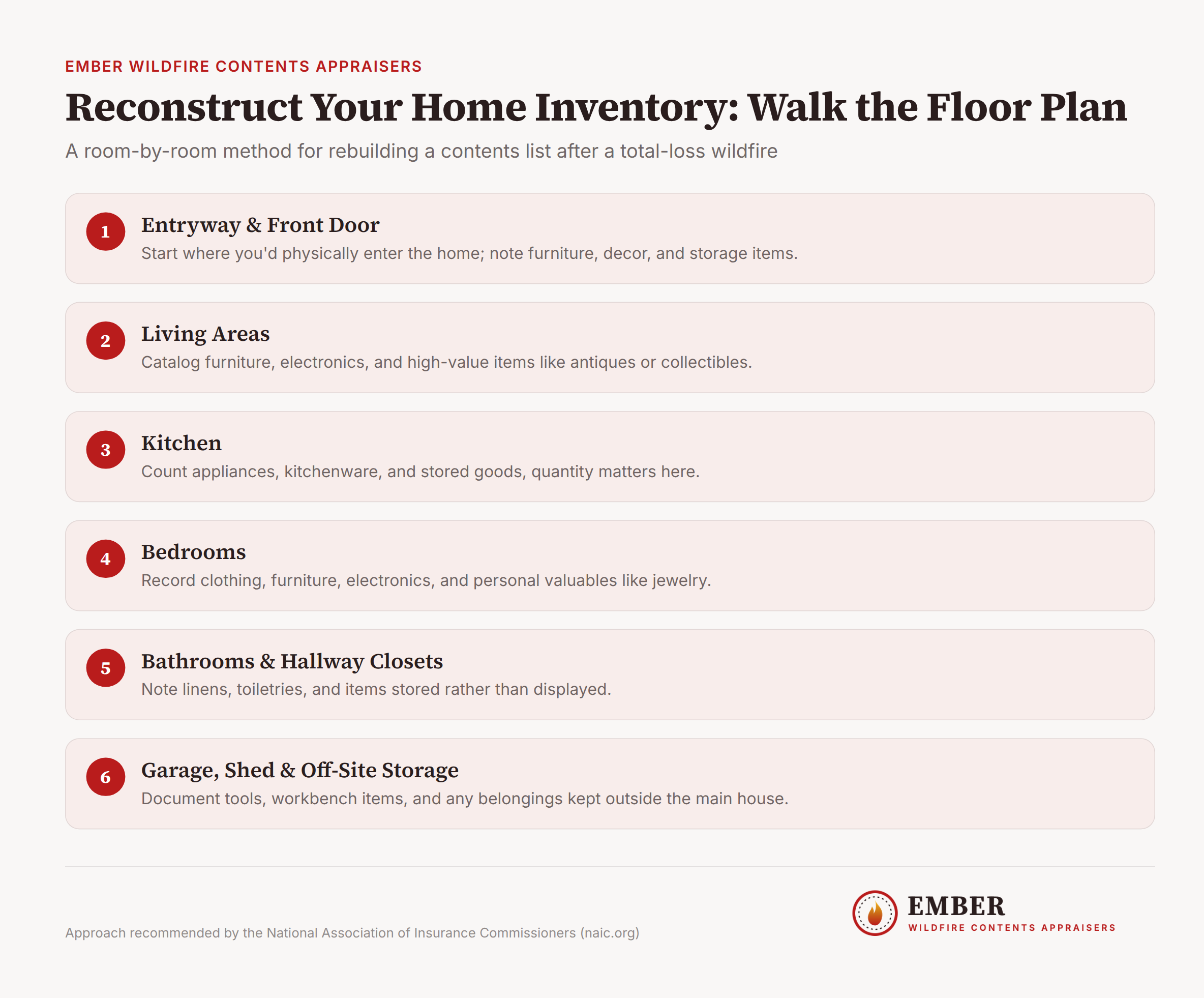
Begin with a floor plan, even a rough hand-drawn one, and move through it the way you would have walked the house: front door, entryway, living room, kitchen, each bedroom, each bathroom, hallway closets, garage, shed, and any off-site storage unit. The National Association of Insurance Commissioners recommends this same room-by-room approach and specifically flags high-value categories such as antiques, electronics, jewelry, collectibles, and firearms that are easy to forget when working from memory alone.
Don't skip the places that feel minor. Linen closets, the junk drawer, the garage workbench, and the shed full of tools each represent real replacement cost that adds up across a full claim. For each space, note:
- What was there: furniture, electronics, clothing, tools, decor, and anything stored rather than displayed.
- Roughly how many: quantity matters most for clothing, kitchenware, books, linens, and tools.
- Condition before the fire: new, lightly used, worn, or already due for replacement.
Mine Your Phone, Cloud Backups, and Social Media for Visual Evidence
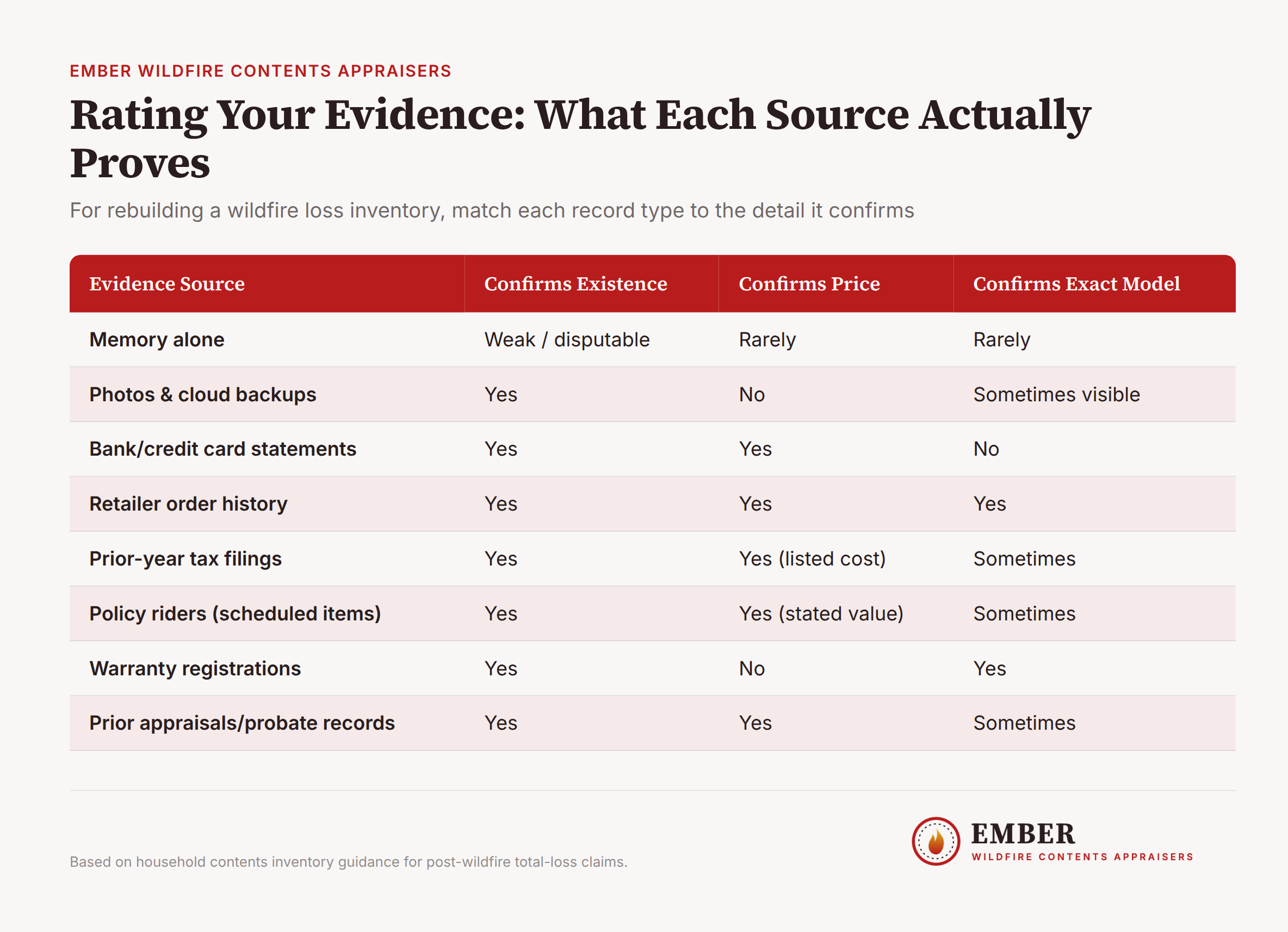
Most households have more photographic proof of their belongings than they realize, it's just never been organized as a home inventory. Scroll through your phone's camera roll, Google Photos or iCloud library, and any cloud backup folder. Holiday photos, birthday pictures, and selfies taken in the kitchen or living room often show furniture, artwork, electronics, and appliances in the background, incidentally documenting exactly what you need.
Social media is another source worth mining: a Facebook post from a renovation, an Instagram photo of a new couch, or a video tour you sent a friend before moving in. Ready.gov's property-documentation guidance recommends pairing any photo or video evidence with a written description that includes the year, make, and model where applicable, since a photo alone rarely identifies a specific model or price point.
Pro tip: Search your photo library by location or date range tied to a specific purchase (a move-in date, a holiday, a renovation) rather than scrolling chronologically through years of photos. It's faster and it surfaces the right rooms.
Pull Credit Card and Bank Statements to Corroborate Purchases
Most card issuers and banks keep digital statement archives going back several years, and many will produce older statements on request even if they've aged out of the online portal. A statement line showing a merchant name, a dollar amount, and a date doesn't describe the item, but it corroborates that a purchase happened, which matters when an adjuster is weighing whether a claimed item is plausible.
Example: A $1,850 charge to a furniture retailer in March 2021 won't tell an adjuster whether you bought a sofa or a dining set, but matched against a photo from that spring showing a new sectional in the living room, it becomes solid corroborating evidence for that specific item.
Request statements for every card and account that might have touched a major purchase: the household's primary credit card, a store card, a joint account, even an old account you no longer use regularly. Larger purchases (appliances, electronics, furniture) are the ones most worth tracking down this way.
Check Retailer Order Histories for Item-Specific Detail
Where a bank statement gives you a merchant and an amount, a retailer's order history often gives you the model number, specifications, and an itemized price, exactly the detail an itemized claim needs. Check the order history and email confirmations for every retailer the household used regularly: Amazon, Target, Best Buy, Costco, Home Depot, and Wayfair are common sources, but don't overlook smaller specialty retailers for items like musical instruments, sporting goods, or tools.
Email is worth a parallel search even if you've deleted individual messages. Search your inbox for terms like "order confirmation," "shipped," or "receipt," and for the names of retailers you remember using. Many retailers will also resend an old receipt or invoice if you contact customer service with an approximate purchase date and account email.
Track Down Tax Records, Policy Riders, and Prior Appraisals
A few paper trails tend to survive outside the house itself, and they're worth chasing down specifically:
- Prior-year tax filings: if you claimed a home office deduction or depreciated business equipment, those filings list specific items and original costs.
- Homeowners or renters policy riders: any item you scheduled separately, such as jewelry, art, or a firearm collection, is already documented with a stated value in your policy file.
- Warranty registrations: many electronics and appliance warranties are registered online under your name and list the model purchased.
- Prior appraisals or probate records: inherited jewelry, art, or collectibles may already have a documented appraisal from a previous owner's estate.
Your insurance agent or broker can usually supply a copy of your policy and any riders even if your personal copy burned, since that file lives on the carrier's side regardless of what happened to the house.
Assembling It All Into One Itemized Inventory
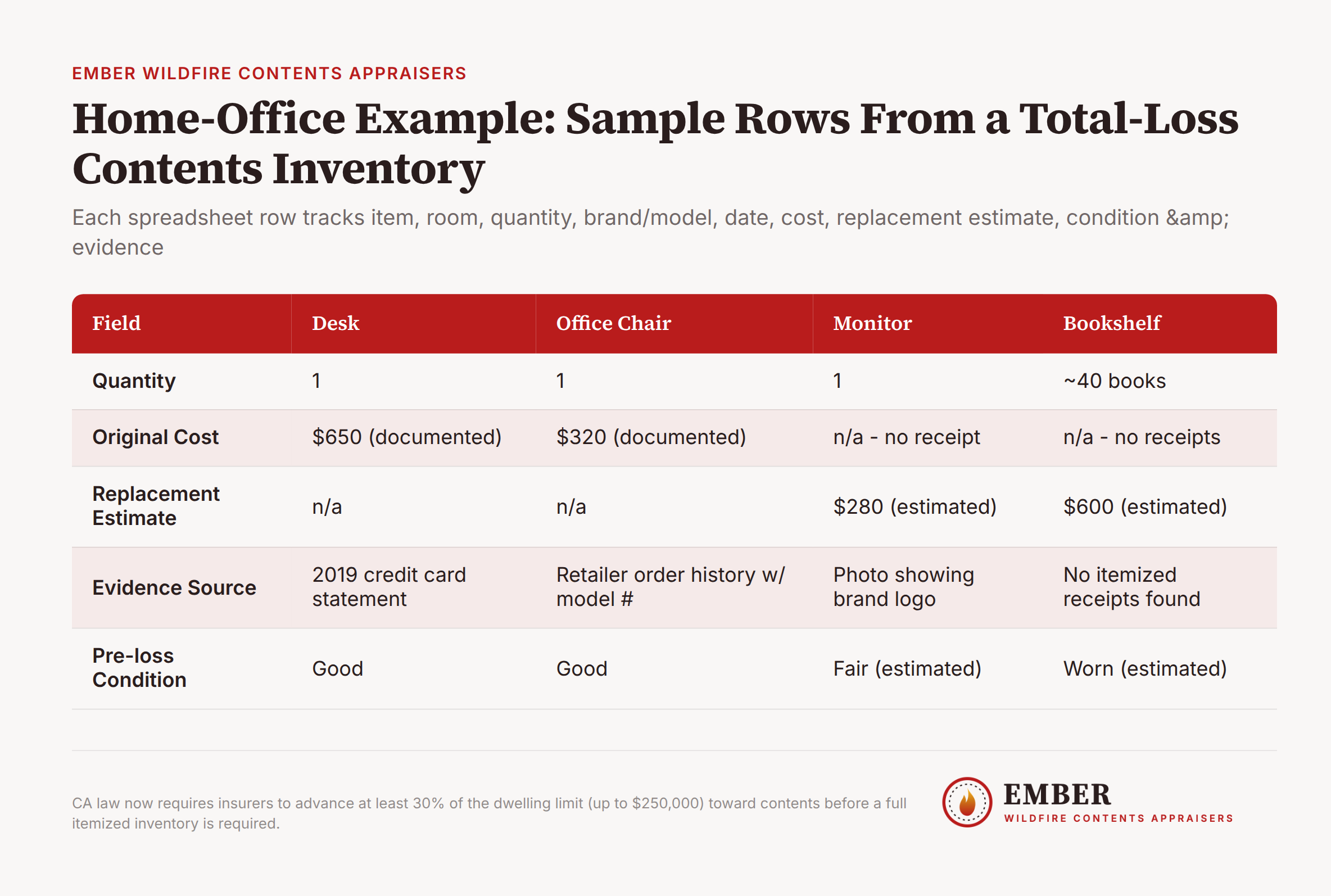
Once you've pulled evidence from memory, photos, statements, and retailer histories, the final step is consolidating it into a single itemized document the insurer can actually process. A spreadsheet organized by room, with one row per item, is the clearest format. Each row should carry:
- Item and room: a plain description plus the room or storage area it came from.
- Quantity: especially important for clothing, books, and kitchenware.
- Brand and model: when known, pulled from retailer order histories or warranty registrations.
- Approximate purchase date: exact when documented, estimated when it isn't.
- Original cost: if a receipt, statement, or order history confirms it.
- Replacement cost estimate: the price of the same or closest comparable model today.
- Pre-loss condition: new, good, fair, or worn.
- Evidence source: which photo, statement, or email supports the line.
Mark any figure you're genuinely estimating as an estimate rather than presenting a guess as an exact number. Adjusters expect some estimation in a total-loss claim; what undermines credibility is an inventory that can't distinguish a documented figure from a guess.
Example: Reconstructing a home office might start with a desk ($650, confirmed via a 2019 credit card statement), an office chair ($320, confirmed via retailer order history with model number), a monitor ($280, estimated from a photo showing the brand logo, no documentation found), and a bookshelf with roughly 40 books ($600 estimated replacement, no itemized receipts). Each line carries a different evidence strength, and the inventory should say so plainly rather than treating all four the same way.
Watch out: Don't discard fire debris, damaged appliances, or partially burned belongings until your adjuster has authorized disposal. Debris can serve as physical evidence of what existed and its condition, and premature cleanup can complicate a disputed line item later.
Pro tip: If building the inventory is taking longer than the deadline your insurer gave you, which is common in a total loss, request an extension in writing rather than letting the deadline pass silently. A dated email or letter documenting the request protects you if the claim timeline is later questioned.
California has added a statutory backstop for exactly this bind. After a total loss, state law now requires insurers to offer at least 30% of the dwelling policy limit, up to $250,000, toward personal property without requiring a fully itemized inventory first. That advance doesn't replace the need to document your actual losses (the real total may run higher, and high-value or specially covered items still need their own support), but it does buy time to do the inventory right instead of rushing it. Our SB 495 explainer covers that advance-payment rule in detail.
When to Bring In a Professional Personal Property Appraiser
A self-assembled spreadsheet works well for ordinary household contents: furniture, clothing, kitchenware, basic electronics. It works less well for jewelry, fine art, collections, firearms, and musical instruments, the categories where insurers often expect a defensible, standards-based value opinion rather than a homeowner's reconstructed estimate.
Our appraisers hold credentials with organizations such as the ISA, ASA, and AAA, and prepare reports in accordance with the Uniform Standards of Professional Appraisal Practice (USPAP). That matters most on disputed or high-value lines, where an adjuster is weighing a stated value against a policy sublimit and wants a report built to a recognized methodology rather than a retailer listing screenshotted from memory.
Engagements for this kind of work are quoted as a fixed fee after we scope the assignment, based on the number of items, the categories involved, and the depth of research each one requires; appraisals are never billed by the hour. If your claim includes scheduled jewelry, an art collection, a gun collection, or inherited heirlooms with no surviving paperwork, that's the point to loop in a professional appraiser rather than estimating those categories yourself.
This article is provided for general informational purposes only and does not constitute legal, tax, or financial advice. Readers should consult a qualified attorney or CPA regarding their specific circumstances.
Rebuilding a household inventory after a total-loss wildfire is slow, methodical work, but it's exactly the kind of work insurers are built to evaluate once it's organized. If your claim includes high-value or specialized items that need a defensible valuation behind them, request an appraisal and our team will scope what your claim actually requires.