
Blog
SB 495 Explained: California's New 60% Wildfire Insurance Advance Payment Rule
California's SB 495 raises the no-inventory wildfire insurance advance payment to 60% of contents coverage, capped at $350,000, starting January 1, 2026. Here is what changed, what the 100-day window means, and why a documented appraisal still matters for the balance of your claim.
California's SB 495 wildfire insurance advance payment rule rewrites how insurers must pay survivors of a total-loss wildfire for destroyed personal property, and it takes effect January 1, 2026. Before this law, the state's no-inventory advance was tied to a dwelling coverage limit that routinely left total-loss households underpaid. SB 495 ties the advance to contents coverage instead and nearly doubles the floor. This guide walks through what changed, what the 100-day payment window means in practice, and why a wildfire contents appraisal still matters for the part of your claim above the statutory advance.
What Is SB 495 and Why Was It Called the "Eliminate the List Act"?
Governor Newsom signed SB 495 on October 10, 2025. The bill was authored by Senator Ben Allen (D-Pacific Palisades) and sponsored by Insurance Commissioner Ricardo Lara, according to the California Department of Insurance. Lawmakers nicknamed it the "Eliminate the List Act" for a reason: the old rule forced wildfire survivors, often displaced and without access to their burned property or records, to compile a full itemized inventory of every destroyed item before receiving any contents payment.
That requirement became a real bottleneck after the January 2025 Los Angeles firestorms destroyed thousands of homes. People with no photographs, no receipts, and no safe access to what was left of their property were effectively being asked to reconstruct a household inventory from memory while living in a hotel. The official bill text confirms the law's short title and January 2026 effective date, as recorded in the SB 495 legislative record. SB 495 folds into a broader package of 2025 wildfire insurance reforms, but its contents-payment rule is the piece that touches nearly every residential total-loss claim in the state.
Old Rule vs New Rule: How the Advance Payment Formula Changed
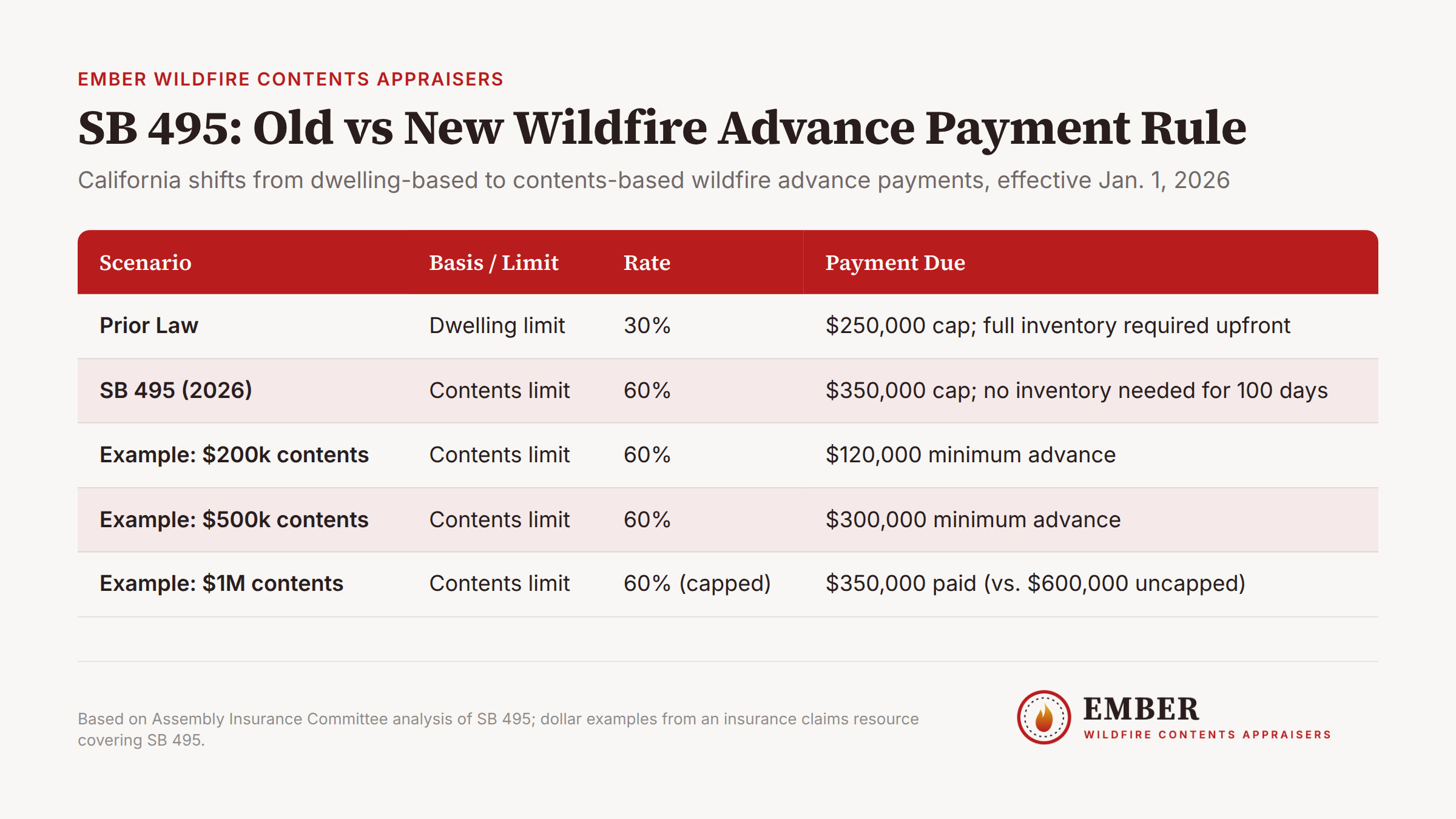
The core change is simple to state but significant in dollars: California swapped a dwelling-based formula for a contents-based one, and raised both the percentage and the cap. Here is how the no-inventory advance payment changed, based on the Assembly Insurance Committee's analysis of SB 495:
| Rule | Calculated From | Minimum Advance | Cap | Inventory Required Upfront? |
|---|---|---|---|---|
| Prior law | Dwelling (structure) coverage limit | 30% | $250,000 | Yes, a full itemized inventory before advance payment |
| SB 495 (effective Jan. 1, 2026) | Personal property (contents) coverage limit | 60% | $350,000 | No, insurer must offer the advance without an itemized list for at least 100 days |
The new formula is calculated from the personal property coverage limit on the policy, not the dwelling limit, so the dollar impact depends on how much contents coverage a household carries. According to a breakdown of the statute's mechanics from an insurance claims resource covering SB 495, the practical math looks like this:
- A policy with a $200,000 contents limit: the insurer must offer at least $120,000 up front.
- A policy with a $500,000 contents limit: the minimum offer rises to $300,000.
- A policy with a $1 million contents limit: 60% would equal $600,000, but the statutory payment is capped at $350,000.
Senator Allen's office framed the old formula as confusing and often insufficient for higher-value properties, since it was tied to a number (the dwelling limit) that had little to do with how much furniture, electronics, and personal items a household actually owned, a point echoed in Senator Allen's press release on the bill.
What Does the 100-Day Payment Window Mean for Wildfire Survivors?
SB 495 requires insurers to offer the 60%/$350,000 no-inventory advance for at least 100 days after a covered total loss tied to a declared state of emergency, without demanding a detailed contents list during that window. The trigger conditions are specific: a residential policy, a total loss of the primary dwelling, a declared state of emergency, and a home that was furnished at the time of loss.
That 100-day period is a floor, not a deadline that cuts off your rights. Our answer on whether insurers must pay contents claims without an itemized inventory walks through how this interacts with a standard proof-of-loss timeline. In practice, it means a household that has lost everything, including the paperwork that would normally support a claim, can receive a meaningful check within weeks rather than waiting months to assemble a line-by-line list of every destroyed item.
SB 495 also gives the Insurance Commissioner authority to describe permissible attestation forms that insurers may ask policyholders to sign instead of a full inventory. A signed attestation is a much lighter lift than an itemized list, but it is still a legal document.
Watch out: an attestation form may ask you to describe general categories of loss (bedrooms, major appliances, electronics) even though the law does not let the insurer demand a full itemized list during the 100-day window. Read it carefully before signing, since it can affect how the remainder of your claim is evaluated later.
The Advance Is a Floor, Not a Ceiling: Why a Full Contents Appraisal Still Matters
The SB 495 advance tops out at $350,000, and most total-loss households owned far more than that once furniture, electronics, clothing, art, jewelry, and everyday personal items are added together. State law still lets a policyholder pursue the remaining balance up to the full contents coverage limit, but that follow-on claim requires exactly the kind of documentation the no-inventory advance was designed to skip.
This is where a professional contents appraisal earns its keep. An appraisal prepared in accordance with USPAP (the Uniform Standards of Professional Appraisal Practice set by The Appraisal Foundation) reconstructs a defensible, itemized record of what was lost and what it was worth, using photographs, receipts, retailer records, social media images, and comparable market data when original documentation burned along with the home. Our appraisers hold credentials with organizations such as the ISA, the ASA, and the AAA, and our guidance on valuing high-value items and collections lost in a wildfire covers how that reconstruction works for art, jewelry, and collectibles specifically.
Pro tip: start gathering whatever records you have immediately, even casual ones. Photos from a family gathering that happen to show furniture in the background, old insurance photos, warranty emails, and credit card statements all give an appraiser a starting point to reconstruct scope and value for the claim above your advance.
Appraisal fees for personal property engagements are quoted as a fixed fee after we scope the assignment, based on the number of rooms or items involved and the depth of documentation required, never billed hourly and never based on the value of what was lost.
Practical Next Steps for Documenting Your Wildfire Contents Claim
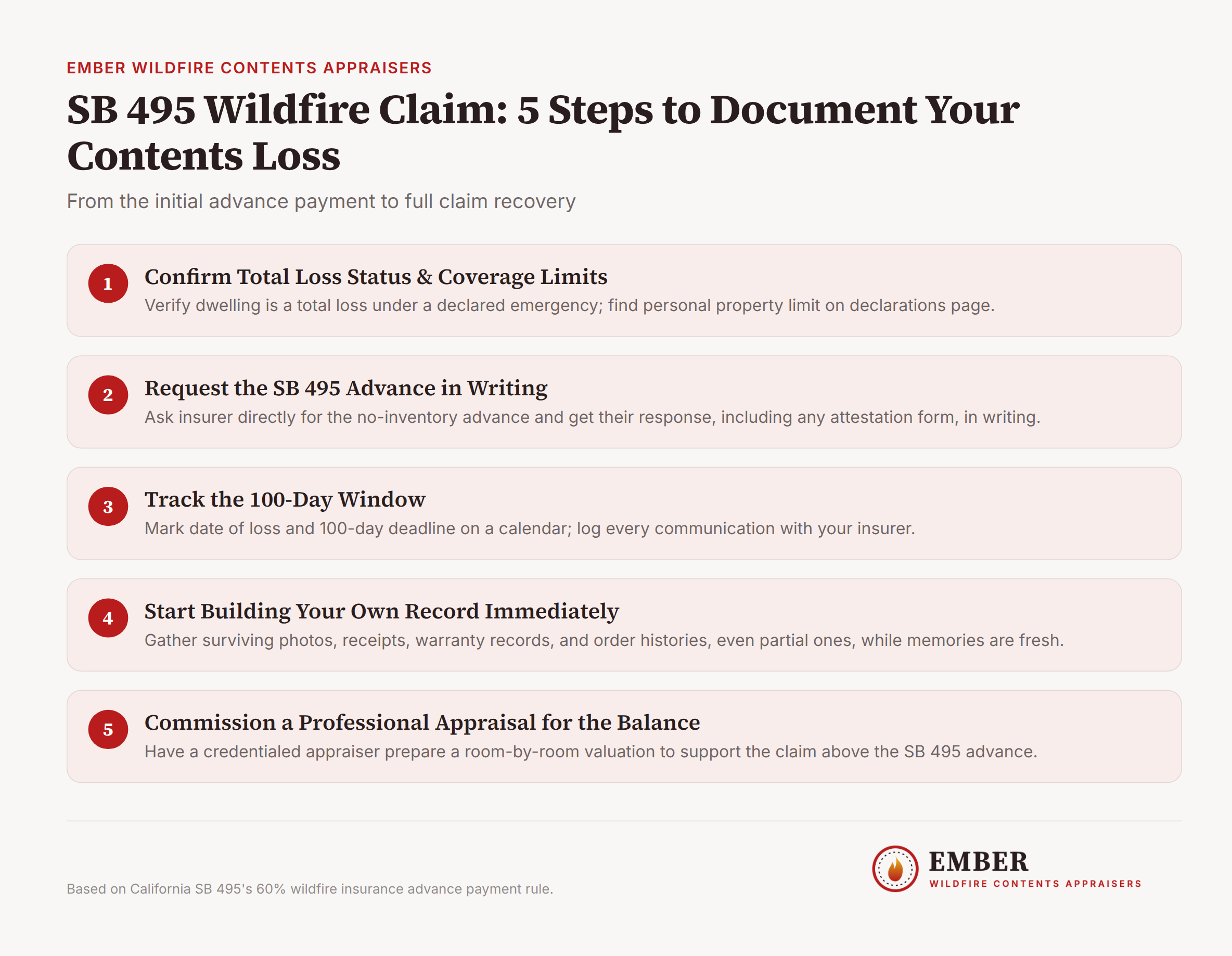
The sequence below reflects how most SB 495 claims actually unfold, from the initial advance through the documentation needed for the balance.
- Confirm Your Total Loss Status and Coverage Limits
- Call your insurer to confirm your dwelling is classified as a total loss under a declared state of emergency, and locate your personal property coverage limit on your declarations page.
- Request the SB 495 Advance in Writing
- Ask your insurer directly for the no-inventory advance payment and get their response, including any attestation form, in writing.
- Track the 100-Day Window
- Mark the date of loss and the 100-day mark on a calendar, and keep a written log of every communication with your insurer during that period.
- Start Building Your Own Record Immediately
- Collect any surviving photos, receipts, warranty records, and online order histories, even partial or informal ones, while memories and evidence are still fresh.
- Commission a Professional Appraisal for the Remaining Balance
- Have a credentialed appraiser prepare a documented, room-by-room valuation to support the portion of your claim above the SB 495 advance.
SB 495 removes the single biggest obstacle that used to stand between wildfire survivors and their first contents payment: the demand for a complete inventory before any money moved. It does not remove the need to document the rest of the claim once that initial check arrives. Survivors who treat the advance as a starting point, not a final settlement, are in a far stronger position when it comes time to recover the full value of what they lost. If you are navigating a total-loss claim and need a documented, standards-compliant valuation of your contents, our team can help you request an appraisal and build the record your claim needs.
This article is provided for general informational purposes only and does not constitute legal, tax, or financial advice. Readers should consult a qualified attorney or insurance professional regarding their specific circumstances.